Celebrating the Legacy of Dolores Huerta
Honoring the life and work of the labor and civil rights icon

Dolores Huerta, the revolutionary Civil Rights icon who helped ignite a movement to empower working people, has died at the age of 96.
As co-founder of the United Farm Workers (UFW), Huerta organized strikes, boycotts, and actions to advocate for the dignity, safety, and human rights of marginalized workers. Her activism went beyond labor rights, advocating for gender equality, reproductive justice, voting rights, and representation for Latino communities.
In 1972, Huerta handed the movement its defining rallying call: “¡Sí, se puede!” Those words empowered a new generation of grassroots organizing, echoing through President Obama’s campaign: Yes, we can. In 2012, President Obama recognized her significant contributions to the labor movement by awarding Dolores Huerta the Presidential Medal of Freedom.
Dolores Huerta helped generations of Americans see what’s possible when people come together to demand a better future.
Humble Beginnings
Huerta was raised in Stockton, California, by her mother, Alicia Chávez Fernández, who worked two jobs to support the family, eventually saving enough money to buy a hotel. The hotel, which largely catered to low-wage farmworkers, became a refuge where those who could not afford to stay were welcomed free of charge.
Huerta went on to teach the children of farmworkers in Stockton and witnessed the harsh realities they faced: Students frequently showed up to class hungry and without adequate clothing. The daily realities of her students inspired her to become a full-time organizer.
Fighting For The Rights Of Farmworkers
Huerta joined the Community Service Organization, a civil rights group, where she lobbied local officials for better living conditions in Stockton’s barrios and advocated for health benefits for farmworkers. Her advocacy work eventually led to the formation of what became known as the United Farm Workers.

A flashpoint in the movement came in 1965 when grape workers in Delano, California—primarily Filipino laborers—asked for support. The Delano workers had been striking for fair wages and humane working conditions while enduring hostility and police violence.
“The farmworkers were only earning about 70 cents an hour at that time — 90 cents was the highest wage that they were earning,” Huerta recalled in a 2017 NPR interview (Opens in a new tab) . “They didn't have toilets in the fields, they didn't have cold drinking water. They didn't have rest periods. People worked from sunup to sundown.”

The resulting strike lasted five years, involving over 3,000 grape workers. Huerta played a leading role by organizing nonviolent marches and public demonstrations despite violent opposition. The movement gained national traction, leading more than 18 million Americans to boycott grapes. Ultimately, the strike secured groundbreaking protections for farmworkers.
¡Sí, se puede!
Huerta continued her activism throughout the remainder of the 20th century, continuing to advocate for the right to unionize and the protections of laborers. In the 1970s, Huerta’s work became increasingly intersectional as she began to focus her attention more heavily on the injustices faced by women farm workers. She observed that women farm workers were at unique risk of sexual violence, and that the children of farm workers had specific concerns for their rights as younger laborers in the fields working alongside their parents. During this time, Huerta began advocating for reproductive rights and more Latina representation in political office.

In 2012, Obama awarded Huerta the nation’s highest civilian honor with the Presidential Medal of Freedom. In his remarks, he recalled reading about her when he was beginning his own work as a community organizer. He also joked that “Dolores was very gracious when I told her I had stolen her slogan, ‘Si, se puede.’ … Knowing her, I’m pleased that she let me off easy because Dolores does not play.”
The Legacy Of Dolores Huerta at the Obama Presidential Center
Opening in 2026, the Obama Presidential Center honored Huerta’s legacy with exhibitions designed to inspire and encourage the next generation of leaders.
An exhibit titled “Honoring Our Nation’s Changemakers” highlights her pioneering work for farmworkers and her 2012 Presidential Medal of Freedom Award. “ Yet With A Steady Beat ,” an art installation by Jeffrey Gibson, prominently features the motto “¡Sí, se puede!” alongside the demand “Queremos un Contrato” (“We Want a Contract”).
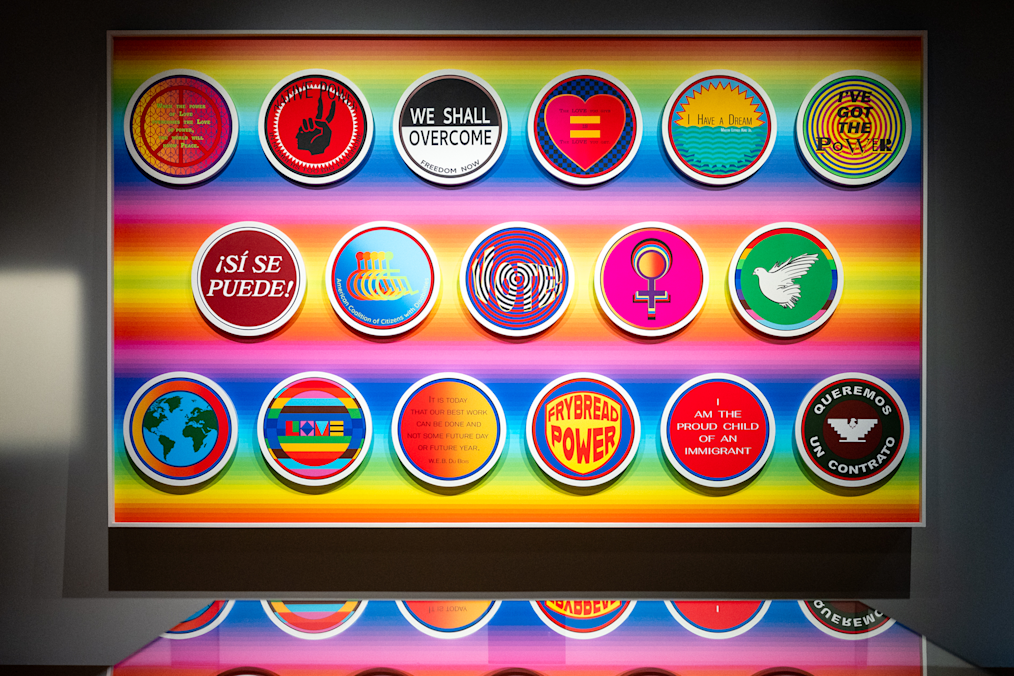
Additionally, the Museum offers “Yes You Can,” an interactive media experience that invites visitors to create personalized badges in multiple languages. Through this exhibit, visitors can choose the Spanish phrase ¡Sí, se puede! to craft their own buttons in various styles, connecting directly with Huerta’s enduring message.
